Editorial illustration.
A useful jewellery display makes each piece easy to see, understand, and compare. Choose a main piece, give it an appropriate stand, and organise the supporting range around it. Height, spacing, lighting, and access should explain the jewellery, rather than turn a small counter into a collection of competing props.
Decide what the counter should help someone choose
Start with the customer's question. They might be comparing necklace lengths, looking for earrings to match a pendant, or choosing a ring from several related designs. A display organised around one of those decisions can be more useful than arranging every available piece by whatever space is left.
Choose one main product or small group for the display. Identify which details need to be visible: the necklace's drop, the earring pair, the ring's setting, or the relationship between matching pieces. That becomes the brief for your fixtures and lighting.
This approach is about making the selection understandable. A stand does not guarantee a sale, and the highest position is not automatically the best position for every item.
Match necklace stands to the chain and pendant
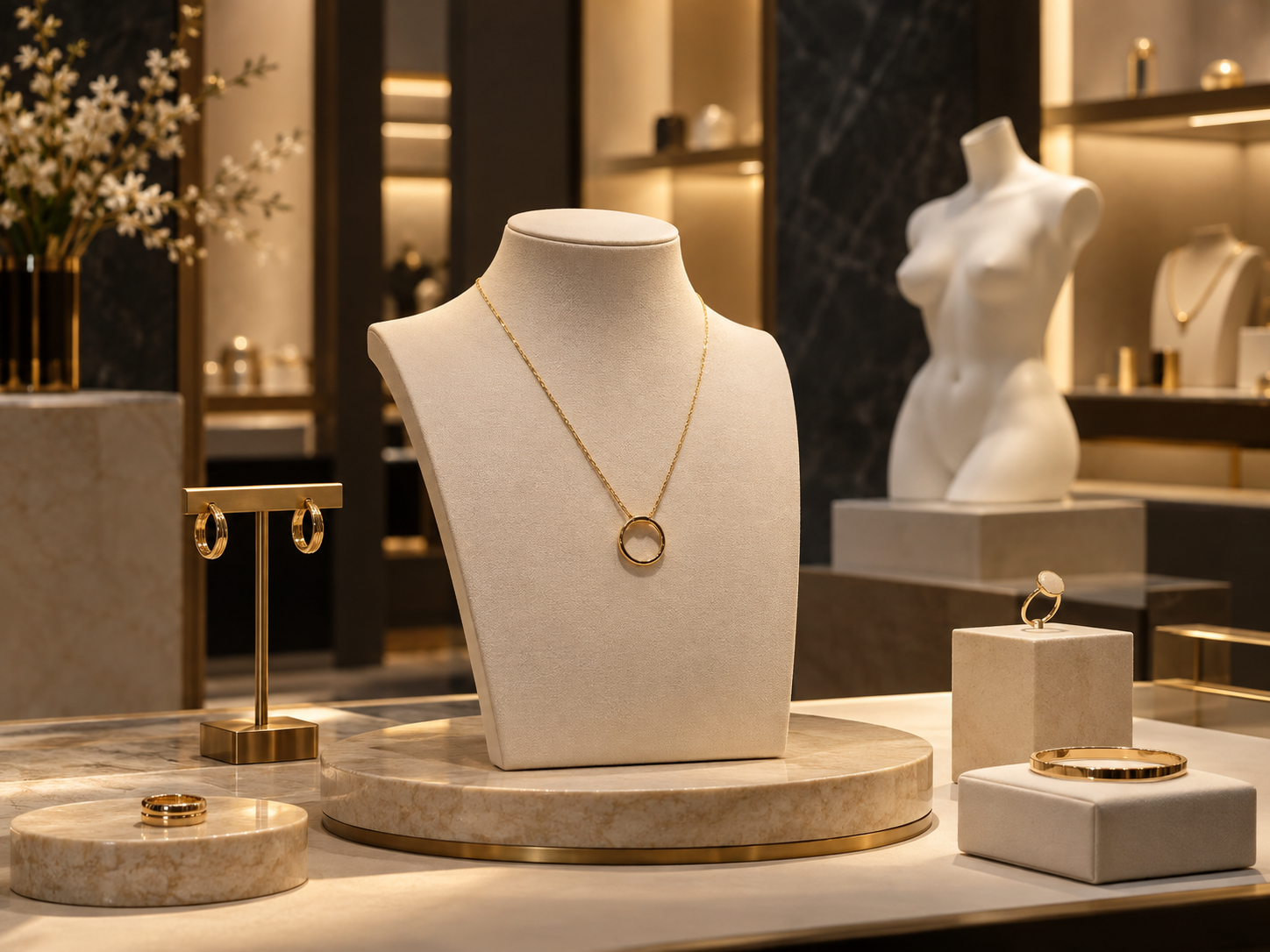
A necklace bust or stand can help show a chain and pendant in a more understandable arrangement than an unexplained pile. Compare the stand's dimensions with the actual necklace, including its length and how the pendant rests.
Check whether the chain sits as you intend, whether part of it disappears behind the support, and whether the pendant reaches the counter. A stand that works for one length may not suit another. Keep the arrangement simple enough that staff can remove a necklace without disturbing several neighbouring pieces.
If you layer necklaces, do so to explain a deliberate combination. Keep individual product identities and prices clear. The customer should be able to tell whether the display represents one set or several separate items.
Give rings and earrings a comparison structure
For small pieces, choose holders that present the features you want compared. A ring tray can be useful for browsing related designs, while a raised holder may give one selected ring more visibility. Flat trays are not inherently wrong; the question is whether the arrangement works from the customer's actual viewing position.
For earrings, show the pair together and check that the holder suits their fastening and shape. Confirm that staff can remove and replace the pieces without making the display untidy. Where jewellery needs protected handling, agree the process with the person responsible for the counter.
Use levels where they improve visibility, but avoid making comparison unnecessarily difficult. A customer comparing several similar rings may need a consistent view more than a dramatic difference in height.
Check the view from outside your working position
Staff often arrange jewellery while leaning over the counter. Customers may see it from further away, through glass, or from a different height. Walk to those positions and inspect the display before deciding it is finished.
Look for reflections, supports that hide details, confusing overlaps, and signs blocking the jewellery. Test the arrangement under the lighting used during normal trading rather than relying only on a close photograph.
Visual Merchandising: Tips, Types & Examples highlights space, lighting, and focal points. For a jewellery counter, translate that into three practical checks: what is easiest to notice, what can be compared, and what is obscured. Those observations give you an actionable way to edit the display.
Choose backgrounds with the real jewellery in place
Compare acrylic, fabric-covered, wooden, or other suitable supports with the actual pieces. Finish and colour should make relevant details visible and suit the store's visual style. Do not assume one background always works best for a particular metal or stone.
Place the same necklace or ring on your shortlisted backgrounds and inspect it under the counter lighting. Check the product, not just whether the empty stand looks attractive. Also ask about the fixture's care instructions and how it will be cleaned between changes.
Use a consistent family of supports where it helps the counter look organised, while allowing a functional exception when a particular piece needs a different holder.
Build one example display before scaling up
Imagine a counter introducing a pendant with matching earrings and a ring. Start with the pendant on an appropriately sized necklace stand, then place the earrings and ring where customers can compare the shared design. Keep the labels readable and make each item easy for staff to identify.
Try a compact arrangement and one with more spacing. View both from the customer position and test how the staff member removes a piece for inspection. Choose the arrangement that explains the range and supports the handling process, rather than deciding in advance that every group needs exactly three levels.
Photograph the finished example and use it as the reference for the next section of the counter. Repeating a useful system is more valuable than copying a display whose purpose nobody can explain.
Keep the counter accurate as stock changes
Assign someone to check the display at opening and after a featured piece is removed or sold. Replace an empty position deliberately, update its label, and confirm that any matching items still belong together. This keeps the arrangement connected to what the store can offer.
Compare relevant options for this display
Our JDVEL007 black velvet necklace stand is listed for showing the shape and drape of a necklace. Start with one necklace on that support, then look at it from the customer’s side of the counter. If the pendant gathers at the bottom, ask for the stand dimensions before you commit to that pairing.
The JDVEL025 three-tier black T-bar stand has three horizontal rounded bars stepping up and back. Its current product description identifies a matte black finish and a flat rectangular base. That gives you a different arrangement from laying several chains beside one another on the counter.
Our JDC003 accessory case has 12 spaces and documented external dimensions of 34.3cm by 23.1cm, with a minimum height of 3.0cm. It offers a defined place for a small selection of bangles or accessories. Those external dimensions do not tell you the size of an individual compartment, so ask if the fit is critical.
| Current option | Check for your display |
|---|---|
| Jewellery Necklace Display Stand (Velvet, Black) — JDVEL007 | Necklace: compare chain length and pendant drop with the actual stand. |
| Jewellery Display Stand, 3 Tier T-Bar, Black — JDVEL025 | Bracelets: check how the selected pieces sit on the tiered bars. |
| Jewellery Display Case (12 Spaces, Bangles & Accessories) — JDC003 | Small pieces: check the actual compartment fit and handling requirements. |
Questions before you decide
Should every piece sit on its own stand?
No. Try a stand for the focal piece and a clearly organised case or row for the supporting selection. The useful test is whether someone can identify and ask about an individual piece, not how many stands you can fit.
Is the jewellery in the photograph included?
Treat jewellery and surrounding styling as examples unless the selected listing explicitly includes them. Confirm the supplied stand or case and any accessories in your enquiry.
For a new fixture enquiry, include the counter dimensions, viewing position, jewellery types, chain lengths where relevant, and any handling requirements. Ask which available supports fit those needs and what parts are included. The goal is a counter that helps someone see and compare the jewellery while remaining straightforward for your team to manage.
Turn your shortlist into a quote
Send the relevant product codes and quantities with your location, required dates and any delivery or collection requirements. Ask what the quoted selection includes before confirming.
Use our contact page to ask about the product or rental you’re considering before you decide.